
UNPAD Nursing Researchers Introduce Family-Centered Stroke Care Model
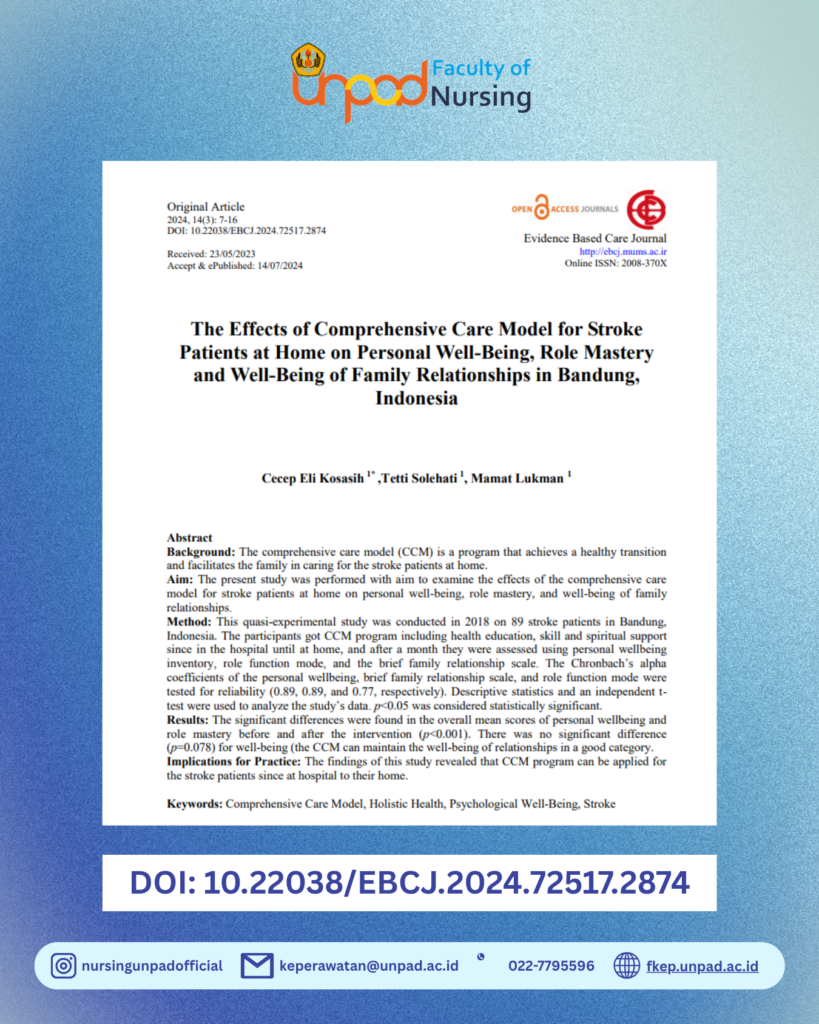
Stroke remains one of the leading causes of long-term disability, and recovery often extends far beyond hospital care. In response, a research team from the Faculty of Nursing, Universitas Padjadjaran, Cecep Eli Kosasih, S.Kp, MNS, Ph.D., Dr. Tetti Solehati, S.Kp, M.Kep., and Mamat Lukman,S.Kp., SKM.,M.Si., conducted a study to assess how a structured home-based intervention could support stroke survivors in Bandung, Indonesia.
The study involved 89 stroke patients and applied a Comprehensive Care Model (CCM) that included health education, practical caregiving skills, and spiritual support, starting from hospital discharge and continuing at home for one month.
Findings revealed that participants who received the CCM intervention experienced:
- Significant improvements in personal well-being (p < 0.001)
- Improved role mastery, indicating better adaptation to daily life post-stroke (p < 0.001)
- No significant changes in the well-being of family relationships (p = 0.078), though this domain was maintained in a positive category
These results highlight the importance of continuing care in the home environment, emphasizing the role of family in rehabilitation. The model contributes to Sustainable Development Goal 3 (Good Health and Well-being) by promoting inclusive and continuous care beyond institutional settings.
📄 Access the full article:
https://doi.org/10.22038/EBCJ.2024.72517.2874
 ID
ID  EN
EN
Tinggalkan Balasan