
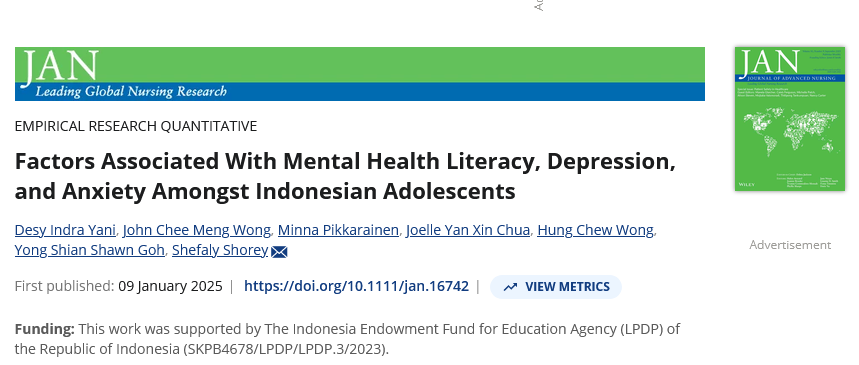
A recent study led by Desy Indra Yani from Universitas Padjadjaran, in collaboration with Metropolitan University, Norway, explored mental health literacy, depression, and anxiety in 615 adolescents. Mental well-being is shaped by a mix of personal factors (gender, physical health, past trauma), family (parental criticism or support), and school/community factors (academic pressure, safety). Interestingly, while better mental health knowledge led to more positive attitudes and help-seeking, it didn’t directly reduce depression or anxiety symptoms.
These results call for more holistic and culturally grounded mental health programs in Indonesia 🇮🇩. Future efforts should promote self-esteem, spiritual support, stress management, sleep hygiene, physical activity, and trauma care, while tackling stigma and building stronger school and family support systems.
This study aligns closely with the United Nations’ Sustainable Development Goals, especially SDG 3 (Good Health and Well-being) by addressing mental health issues, and SDG 4 (Quality Education) by emphasizing the role of knowledge and supportive school environments.
📖 Read the full article via DOI: https://doi.org/10.1111/jan.16742
 ID
ID  EN
EN
Tinggalkan Balasan