
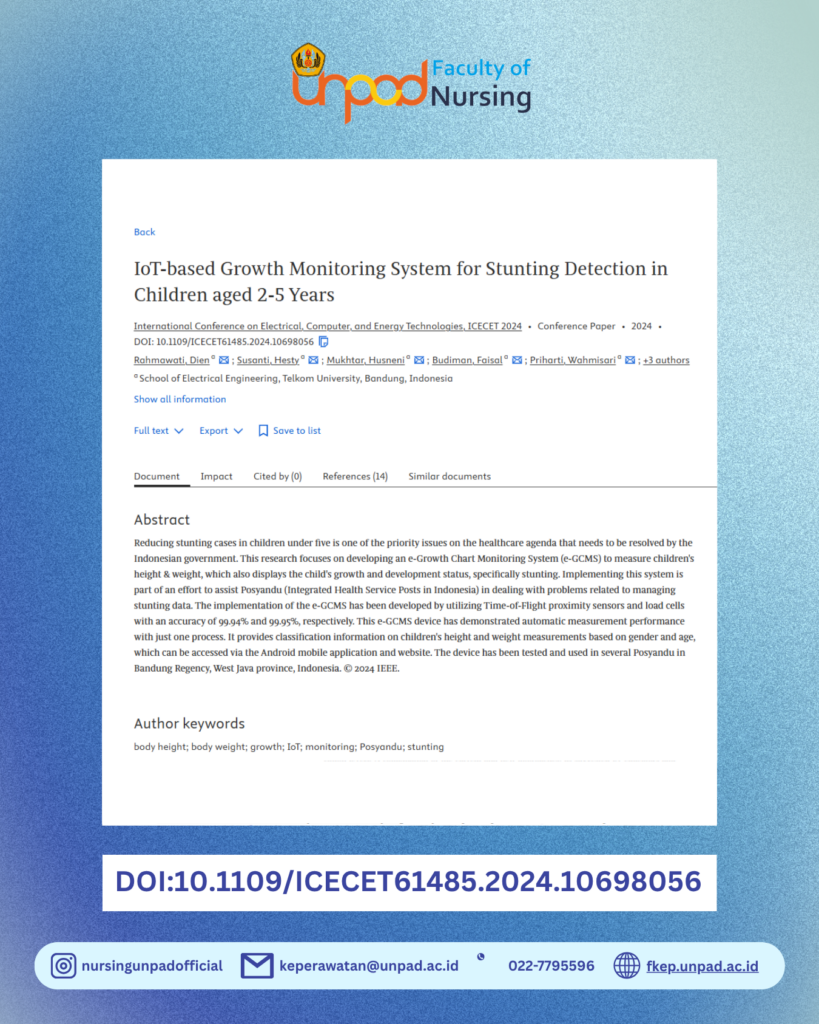
IoT-Based Innovation for Early Stunting Detection in Indonesian Children
A research collaboration between the Faculty of Nursing, Universitas Padjadjaran, School of Electrical Engineering, Telkom University, Bandung, Indonesia, and the School of Creative Industries, Telkom University, has resulted in the development of an IoT-based e-Growth Chart Monitoring System (e-GCMS) to support early detection of stunting in children aged 2–5 years. With stunting remaining a pressing public health challenge in Indonesia, especially in rural areas, this system offers a smart solution tailored to the needs of community-based services like Posyandu.
The e-GCMS device uses Time-of-Flight proximity sensors and load cells, achieving 99.94% accuracy for height and 99.95% for weight measurements. Its compact design allows for automatic measurement in one step, significantly easing the workload of health volunteers. The device is connected to a mobile application and website, enabling real-time growth classification based on WHO standards for age and gender.
The system has been tested across several Posyandu in Bandung Regency, West Java, with promising results in terms of accuracy and ease of use. While Telkom University contributed technological innovation and system engineering, the involvement of Universitas Padjadjaran brought a critical public health perspective to ensure the system meets the practical needs of frontline health workers and aligns with maternal and child health priorities in Indonesia. This IoT-based e-Growth Chart Monitoring System (e-GCMS) directly supports Sustainable Development Goal (SDG) 2: Zero Hunger, specifically Target 2.2, which aims to end all forms of malnutrition and reduce stunting in children under five by 2025. Additionally, it contributes to SDG 3: Good Health and Well-Being, reinforcing the goal to ensure healthy lives and promote well-being for all ages through improved child health monitoring and preventive care.
📄Full Article:
DOI: 10.1109/ICECET61485.2024.10698056
 ID
ID  EN
EN
Tinggalkan Balasan